
- What Thalassemia is
- Why testing is important
- What problems may happen if both partners are carriers
- And most importantly, how science can help you have a healthy baby
What is Thalassemia?
Thalassemia is a disease that affects your blood. It is passed from parents to children through genes. People with this condition have less hemoglobin in their blood, which carries oxygen in the body. There are two types: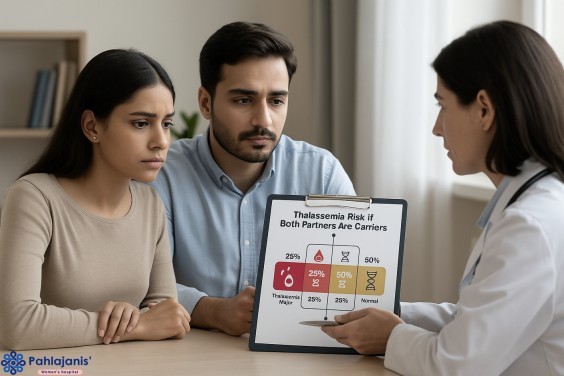
- Thalassemia Minor (The "Carrier"): If you have Thalassemia Minor, you’re a "carrier." You likely feel completely healthy – maybe you didn’t even know you had it! Carriers have slightly less healthy red blood cells, but it doesn’t affect daily life. The onlyrisk? If your partner is also a carrier, it can pass to your children.
- Thalassemia Major (The Serious Illness): Babies born with Thalassemia Major face lifelong struggles. They need blood transfusions every 3-4 weeksjust to survive. Without these, they become very weak. Treatment costs ₹3-5 lakhs per year – like buying a new car annually. Sadly, most don’t live beyond age 30 due to heart or liver damage.
What If Both Partners Have Thalassemia Minor?
If both husband and wife have Thalassemia Minor, there is a 25% chance (1 in 4) that their baby may be born with Thalassemia Major. If both parents carry Thalassemia Minor, genetics work like this:- 25% chance: Baby is healthy (normal genes).
- 50% chance: Baby is a carrier like parents (no health issues).
- 25% chance: Baby has Thalassemia Major (serious illness).
What Happens to a Baby with Thalassemia Major?
A child with Thalassemia Major cannot make enough healthy blood. This causes:- Extreme weakness
- Pale skin
- Swelling of the stomach due to liver and spleen enlargement
- Slow growth
- The child needs blood transfusions for life
Can Thalassemia Major Be Cured?
The only possible cure is a Bone Marrow Transplant (BMT). But this:- Is very expensive
- Needs a perfect match
- Has many risks
Why Should You Get Tested Before Marriage or Pregnancy?
A simple blood test can tell you if you are a Thalassemia Minor carrier. It’s called HPLC test or Hemoglobin Electrophoresis. If only one partner is a carrier – no problem. If both are carriers – there is a risk to the baby. That’s why it’s very important to get tested before marriage or pregnancy.How IVF with PGD Can Help?
Modern science gives us a way to stop Thalassemia Major even if both parents are carriers. This is possible through:- IVF ("Test-Tube Baby"):
- Doctors collect eggs from the mother and sperm from the father.
- They combine them in a lab to create embryos (early-stage babies).
- PGD (Genetic "Quality Check"):
- When embryos are 5 days old, scientists remove a few cells.
- They check the DNA for Thalassemia genes – like scanning a barcode.
- Only healthy embryos(without Thalassemia Major) are placed in the mother’s womb.
What If You’re Already Pregnant?
Don’t panic! You still have options:- CVS Test (10-13 weeks): Doctors take a tiny piece of the placenta (afterbirth) with a needle. It’s tested for Thalassemia genes. Result in 1-2 weeks.
- Amniocentesis (15-20 weeks): Doctors take a spoonful of fluid around the baby. Safer than CVS, but done later.
If the baby has Thalassemia Major:
- You can legally end the pregnancy before 24 weeks in India.
- NGOs like Thalassemics Indiaprovide free counseling for couples.
What If You Are Already Married?
If you are already married and both of you have Thalassemia Minor:- Do IVF with PGD to avoid risk
- Or do CVS/Amniocentesis in early pregnancy
- You can also consider donor sperm or egg to avoid the faulty gene
What Are Donor Sperm or Donor Egg Options?
If both partners are Thalassemia carriers, using donor sperm or egg is one more safe option. Doctors use sperm or eggs from healthy donors who are not carriers. This ensures that the baby will not get Thalassemia Major. Many couples choose this option and go on to have healthy children.Final Words: Science Se Solution Hai
Good news is — today we have solutions. You can avoid Thalassemia Major and have a healthy baby by:- Doing a simple Thalassemia test
- IVF with PGD
- Prenatal testing like CVS or Amniocentesis
- Using donor sperm or egg if needed
- Medical abortion (legal up to 24 weeks) if the fetus has Thalassemia Major
Frequently Asked Questions (FAQs)
- What is Thalassemia?
- What is the difference between Thalassemia Minor and Major?
- Minor: You are a carrier. You are healthy or may have mild anemia.
- Major: A serious condition. You need regular blood transfusions to live.
- How can I know if I have Thalassemia Minor?
- Can two Thalassemia Minor people have a healthy baby?
- Is Thalassemia Major curable?
- What is PGD in IVF?
- What are CVS and Amniocentesis?
- Can we prevent Thalassemia before birth?
- Is it okay to marry someone with Thalassemia Minor?
- What can be done if the baby has Thalassemia Major?
- Medical abortion (allowed up to 24 weeks in India)
- Continue pregnancy with proper care
- Use donor sperm/egg in future