Introduction: The Question No One Warns You About
You went to a routine check-up. The doctor mentioned a hormone test. And then, out of nowhere, you heard three words that changed everything: diminished ovarian reserve.
Your stomach dropped. Does this mean you can't have children? Is it too late? Did you do something wrong?
Take a breath. You did not do anything wrong. And no, this does not mean the door is closed.
In my years working closely with fertility patients across Chhattisgarh, I have sat with dozens of women who heard this exact diagnosis and panicked. Most went on to build the families they wanted, once they understood what was actually happening in their bodies.
This is the conversation I wish every woman could have the moment she hears "DOR" for the first time.
What Exactly Is Diminished Ovarian Reserve?
Bottom line: DOR simply means your ovaries have fewer eggs left than expected for your age, or the eggs that remain respond less well to fertility hormones.
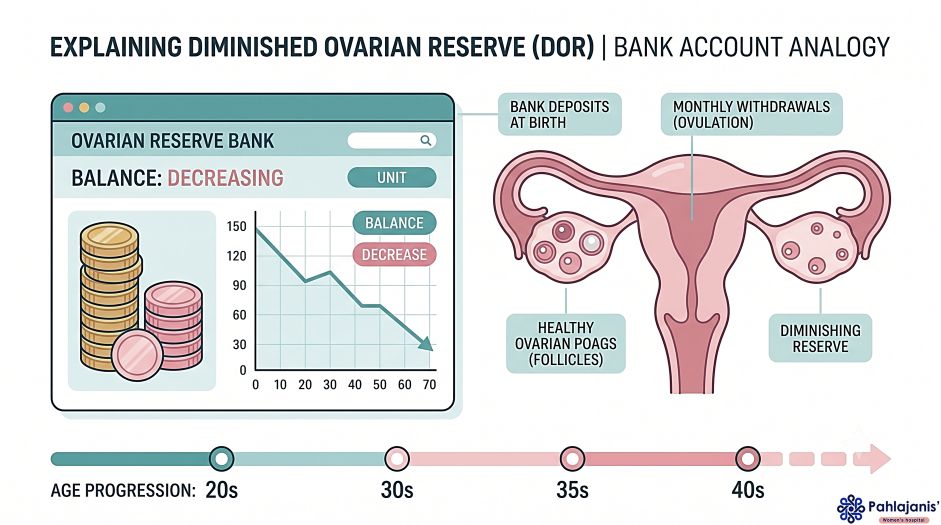
Think of your ovarian reserve like a bank account you were given at birth. You are born with all the eggs you will ever have, roughly 1-2 million. By puberty, that number has already dropped to around 300,000-400,000. Every month after that, your body uses up a batch, whether or not you get pregnant.
DOR does not mean you have zero eggs left. It means your "account balance" is lower than what is typical for someone your age. Some women in their late 20s have the reserve of a 35-year-old. Some women in their late 30s have a reserve much better than average. Everybody has its own timeline.
How Common Is DOR, really?
Bottom line: DOR is far more common than most women realize, and it is not limited to older women.
Here is what recent research actually shows:
Age Group | Estimated Prevalence of DOR |
20-24 years | Under 4% |
25-29 years | 6% |
30-34 years | 10-11% |
35-39 years | Around 28% |
40-44 years | Nearly 70% |
45-49 years | Over 90% |
A large 2023 clinical study tracking over 13,000 women found the overall prevalence of diminished ovarian reserve was 37.2%, with age-adjusted prevalence at 38.4%. That means more than 1 in 3 women tested had some degree of reduced reserve.
Among women specifically seeking fertility treatment, the numbers are even wider. Diminished ovarian reserve incidence among infertile women ranges from 6% to 64% depending on age, and one large US analysis found the prevalence of low ovarian reserve patients rose from 19% to 26% between 2004 and 2011, with an increase of 42% specifically among patients younger than 40.
Why does this matter for you? Because DOR is being diagnosed in younger women more often than it used to be. This is not just a "40-plus" issue anymore. Reported DOR prevalence generally ranges between 10% and 35%, and it now tends to occur at younger ages than before.
What Causes Diminished Ovarian Reserve?
Bottom line: DOR is caused by a mix of age, genetics, medical treatments, lifestyle, and sometimes unknown factors. It is rarely just one thing.
Let's break these down simply, like separate rooms in a house.
1. Natural Aging (The Biggest Factor)
This is the most common cause. Egg quantity and quality naturally decline as you get older, and the decline speeds up after age 35. This is biology, not a personal failure.
2. Genetic Conditions
Some women are simply born with fewer eggs, or their eggs decline faster due to genetics. Conditions like Fragile X premutation or Turner syndrome are known genetic contributors. If your mother or sister went through early menopause, your risk may be higher too.
3. Medical Treatments
Chemotherapy, pelvic radiation, and certain ovarian surgeries (like removing a cyst) can damage egg supply. A recent 2025 review confirms that DOR caused by medical treatment can occur during chemotherapy, pelvic radiation, and ovarian surgery, while DOR that happens on its own can be linked to ovarian tumors, unknown (idiopathic) causes, or genetic factors.
4. Autoimmune Conditions
Sometimes the immune system mistakenly attacks ovarian tissue, speeding up egg loss. This is more common than most people think and often goes undiagnosed.
5. Infections
Certain pelvic infections can silently damage ovarian function over time.
6. Lifestyle and Environmental Factors
Smoking is one of the strongest lifestyle links to earlier ovarian decline. Chronic stress, poor nutrition, and toxin exposure may also play a role.
7. Unexplained (Idiopathic) DOR
Sometimes, despite every test coming back clean, doctors cannot pin down a cause. This is frustrating, I know. But "unexplained" does not mean "untreatable."
A quick reality check: In many women, DOR is a combination of two or three of these factors working together, not just one isolated cause.
How Is DOR Diagnosed?
Bottom line: DOR is usually diagnosed through a simple blood test (AMH) and sometimes an ultrasound, not through guesswork.
Here are the three main tests doctor’s use:
AMH (Anti-Müllerian Hormone) blood test – This is the most reliable indicator. It can be done on any day of your cycle.
FSH (Follicle Stimulating Hormone) blood test – Usually done on day 2 or 3 of your period.
Antral Follicle Count (AFC) – A quick vaginal ultrasound that counts visible follicles in your ovaries.
Doctors typically use combined criteria. For instance, ACOG and ASRM guidelines define DOR when AMH is under 1.0 ng/mL or FSH is above 10.0 mIU/mL. No single test tells the whole story, which is why good doctors combine two or three of these before giving you a diagnosis.
DOR vs. Menopause vs. Infertility: What's the Difference?
This is where I see the most confusion, and honestly, the most unnecessary fear.
Condition | What It Means |
DOR | Fewer eggs than average for your age, but you still ovulate and have periods |
Inability to conceive after 12 months of trying (6 months if over 35) | |
Premature Ovarian Insufficiency (POI) | Ovaries stop working mostly before age 40 |
Menopause | Complete, permanent end of periods and egg release |
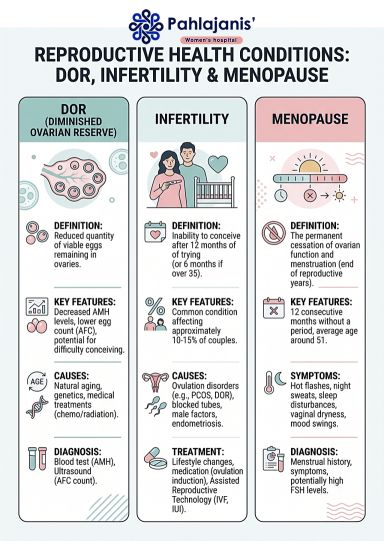
DOR is not menopause. It is not the end of your fertility story. It is a signal, a piece of information that helps you and your doctor make timely decisions.
Can You Still Get Pregnant with DOR?
Bottom line: Yes, many women with DOR conceive naturally or with fertility treatment. DOR affects egg quantity, not automatically your chance of pregnancy.
I want to be honest with you here, because false hope helps no one, and neither does false despair.
What DOR does affect:
The number of eggs available for a treatment cycle
Sometimes egg quality, especially with age-related DOR
The response to fertility medications during IVF
What DOR does NOT automatically mean:
That you cannot conceive naturally
That every pregnancy attempt will fail
That IVF won't work for you
Interestingly, a 2025 single-center fertility clinic study found something reassuring: reduced ovarian reserve is linked to the rate of chromosomally normal (euploid) embryos, meaning quality outcomes can still be favorable even when quantity is lower. Fewer eggs retrieved does not always mean fewer healthy options.
The single biggest factor in your outcome is time. The earlier you understand your reserve, the more options you have, whether that's trying naturally with guidance, considering egg freezing, or starting IVF sooner rather than later.
Actionable Steps You Can Take Right Now
If you suspect DOR or just received the diagnosis, here is exactly what to do next:
Get an AMH test done this month. It can be done any day of your cycle, with one blood draw.
Ask for a repeat test if the first result surprises you. AMH can fluctuate slightly. One low reading deserves a second look before you panic.
See a reproductive endocrinologist, not just a general gynecologist. A specialist reads these numbers in context with your age, cycle history, and family goals.
Stop smoking immediately if you smoke. This is one of the few DOR risk factors you can directly control.
Track your cycle for 2-3 months. Note cycle length and changes. Bring this record to your appointment.
Ask about egg freezing if you're not ready for pregnancy yet. Worth discussing even if you decide against it later.
Talk to a mental health professional if this diagnosis is weighing on you. Fertility stress is real, and you deserve support too.
Involve your partner early. Fertility is a shared journey.
Where to Get Tested in Raipur, Bilaspur, and Bhilai
Bottom line: Chhattisgarh now has established fertility centers and diagnostic labs offering AMH testing and reproductive endocrinology consultations, so you do not need to travel to metro cities for initial evaluation.
Cities like Raipur have seen a steady rise in dedicated IVF and fertility clinics over the past several years, alongside diagnostic chains offering AMH and hormone panels. Bilaspur and Bhilai residents increasingly have local access too, though for advanced treatment like IVF with donor eggs or complex cases, many patients still travel to Raipur's larger fertility centers.
My suggestion: Start with a local AMH blood test at any NABL-accredited lab in your city. If results indicate DOR, ask your gynecologist for a referral to a reproductive endocrinologist in Raipur for a full evaluation.
If you're looking for specialized care closer to home, Pahlajanis' Women's Hospital & IVF Center is worth knowing about. With over 45 years of experience in women's healthcare and centers across Raipur, Bhilai, and Bilaspur, they offer AMH testing, fertility evaluation, and advanced ART treatments under one roof. Their specialists guide patients through each stage of the fertility journey, which can make a real difference when you're processing a DOR diagnosis and want answers close to home instead of a long trip to a metro city.
Conclusion
Hearing "diminished ovarian reserve" for the first time can feel like the ground shifting under you. I understand that. But a lower number on a lab report is information, not a verdict.
DOR is common, it's manageable, and countless women with this exact diagnosis have gone on to become mothers, whether through natural conception, assisted reproduction, or other paths to parenthood. What matters most now is not the diagnosis itself, but what you do with the time and information you have.
So, here's a question worth sitting with: if you found out today that your fertility window might be shorter than you assumed, what is one step you would take this week?
I'd love to hear your thoughts, questions, or experiences in the comments below.
FAQs
Can diminished ovarian reserve be reversed naturally?
No, DOR generally cannot be reversed because egg quantity is set at birth. Lifestyle changes like quitting smoking and managing stress may help slow further decline.
What AMH level is considered diminished ovarian reserve?
Most guidelines consider AMH below 1.0 ng/mL as DOR, though ranges vary slightly by lab and age. Always interpret your number with a fertility specialist, not a generic online chart.
Is diminished ovarian reserve the same as early menopause?
No. DOR means fewer eggs than average for your age while periods continue normally. Early menopause means periods have stopped completely, usually before age 45.
At what age should women get their ovarian reserve tested?
There's no single "right age," but many specialists recommend testing by your early 30s if you plan to delay pregnancy, or sooner with a family history of early menopause.
Does diminished ovarian reserve affect IVF success rates?
Yes, DOR can reduce eggs retrieved per cycle. But quality doesn't always decline proportionally, so many women with DOR still achieve pregnancy through IVF with a tailored plan.
Disclaimer: This content is for informational purposes only and does not constitute medical advice. Always consult with a qualified healthcare professional at Pahlajanis Hospital for clinical concerns.